


How Much RV Solar Do You Actually Need? RV solar system sizing A Real-World Guide for RV Owners

Most RV owners get their RV solar system sizing wrong the first time. The consequences get pricey. Undersized systems force batteries to overwork and fail prematurely, while oversized setups waste money on unused capacity. Determining how much solar you need for your RV isn't guesswork. It's about matching your actual power consumption with the right combination of solar panels and batteries. A 100-watt solar panel generates 30 amp-hours per day, but your needs depend on travel style, appliances, and weather conditions. In this piece, I'll walk you through calculating ground power usage and sizing each component while avoiding the common mistakes that lead to frustration on the road.
Calculate Your Real-World RV Power Usage
Accurate RV solar system sizing starts with knowing exactly how much power you consume. Walk through your RV and create an inventory of every electrical device. This gives you the foundation for proper system design.
List All Devices and Their Wattage
Start by listing every appliance in your RV. Major appliances include air conditioners, refrigerators, microwaves and water heaters. Electronics like TVs, computers and phone chargers matter too. So do 12V systems such as water pumps, fans and slides.
Check manufacturer labels or manuals to find wattage ratings marked as "watts" or "W". If only amps are listed, multiply by voltage (120V for AC appliances, 12V for DC devices). To cite an instance, a 100W laptop running 5 hours per day consumes 500Wh. A 120W fridge running 8 hours uses 960Wh.
Measure Actual Daily Usage Hours
Be realistic about runtime. Air conditioning runs 8-16 hours in extreme weather but only 0-4 hours in mild conditions. Refrigerators cycle for 8-12 hours total runtime per day. Lights operate 4-8 hours depending on season. TVs and entertainment systems run 2-8 hours based on your lifestyle.
The 24-Hour Camping Test Method
Monitor actual consumption using power meters or smart surge protectors that track usage hourly, daily and monthly before you finalize your calculations. This ground data reveals patterns you might miss with estimates alone.
Calculate Total Daily Watt-Hours
Multiply watts by hours to get watt-hours for each appliance (Watts × Hours = Wh). A 1,500W air conditioner running 8 hours equals 12,000 Wh. Sum all appliance watt-hours for your total consumption.
Account for Peak Power Demand
Add 15-20% buffer capacity for inverter losses and system inefficiencies. This accounts for conversion losses and protects against underperforming on cloudy days. Peak power determines inverter size, as appliances with motors draw 3 to 7 times their listed wattage at startup.

How to Size an RV Solar System Component by Component
Once you know your daily power consumption, sizing each component becomes straightforward. Every RV solar system has three core parts: solar panels, batteries, and a charge controller. You'll need an inverter if you plan to run AC appliances.
Determine Solar Panel Wattage Needed
A 100-watt solar panel generates around 30 amp-hours per day under typical conditions. Divide your daily amp-hour usage by 30 to determine how many 100-watt panels you need. You'd need roughly 500 watts of solar panels (five 100-watt panels producing 150 amp-hours) if you consume 139 amp-hours daily. Build in 20-25% extra capacity above your minimum requirements to account for cloudy weather.
Size Your Battery Bank for Off-Grid Days
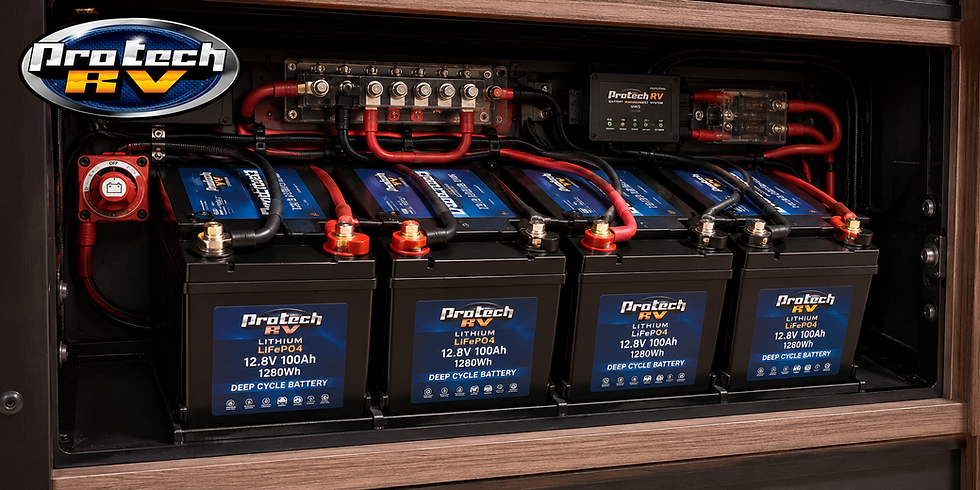
Battery sizing depends on how many days you want to operate without sunlight. Multiply your daily power usage by 4 days with lithium batteries, then divide by 0.8 (the recommended depth of discharge). You can only discharge lead-acid batteries to 50%, so divide by 0.5 instead. Most RVers need between 50Ah and 200Ah of usable capacity per day.
Choose the Right Charge Controller Type
PWM (Pulse Width Modulation) controllers work well for smaller systems under 440 watts and cost less. MPPT (Maximum Power Point Tracking) controllers are 5-30% more efficient and better for larger installations. MPPT controllers convert excess voltage into amperage and operate at maximum power voltage. MPPT delivers by a lot better performance for systems above 400 watts or cold climates where voltage increases.
What Size Inverter Do I Need for My RV
Add up the wattage of all devices you'll run at once, then add 20% for safety margin. A 2000- or 3000-watt inverter is most common for RVs. Match your inverter to battery capacity: lithium batteries require a minimum of 100Ah per 1000 watts of inverter capacity.
Match All Components to Your System Voltage
Most RVs use 12V systems, but 24V systems reduce current by half and allow smaller wire gages with greater efficiency. Higher voltage systems support larger inverters: 12V systems max out around 5,000 watts, while 24V can handle up to 10,000 watts.
Ready to take the guesswork out of RV solar system sizing? Pro Tech RV can design and install a custom solar setup tailored to your exact power needs, whether you're weekend camping or living off-grid. Our team builds reliable power solutions that perform in ground conditions, from solar panel upgrades and lithium battery conversions to full electrical system design. Don't let an undersized system limit your travels. Contact Pro Tech RV today and get expert help building the right solar setup for your RV lifestyle.
Real-World Factors That Change Your Solar Needs
Your theoretical calculations only tell half the story. Real-life conditions alter how much solar power for RV you actually need.
Your Travel Style and Boondocking Frequency
Weekend warriors parking in campgrounds with hookups need minimal solar capacity. Full-time boondockers require resilient systems. Plan for 400-800 watts of solar as the typical range if you camp without hookups frequently. Power-hungry setups exceed 800 watts. Occasional boondockers can start smaller and expand later.
Weather Conditions and Regional Sunlight Hours
Most areas in the United States average between 3 to 5 peak sun hours. Arizona, Nevada, and California receive the highest sunlight, while Alaska, Michigan, Ohio, and Washington get much less. Cloudy days reduce solar panel output to 10-25% of normal capacity. Shade parking to stay cool defeats the purpose since solar panels need sun exposure.
Roof Space Limitations and Panel Placement
Measure your roof and account for air conditioners, vents, and other obstructions. Most RVs use sixty-cell panels measuring about 67"x40". Ground-deployed panels positioned at optimal angles are more efficient than roof-mounted panels.
Lithium vs Lead-Acid Batteries for RV Solar
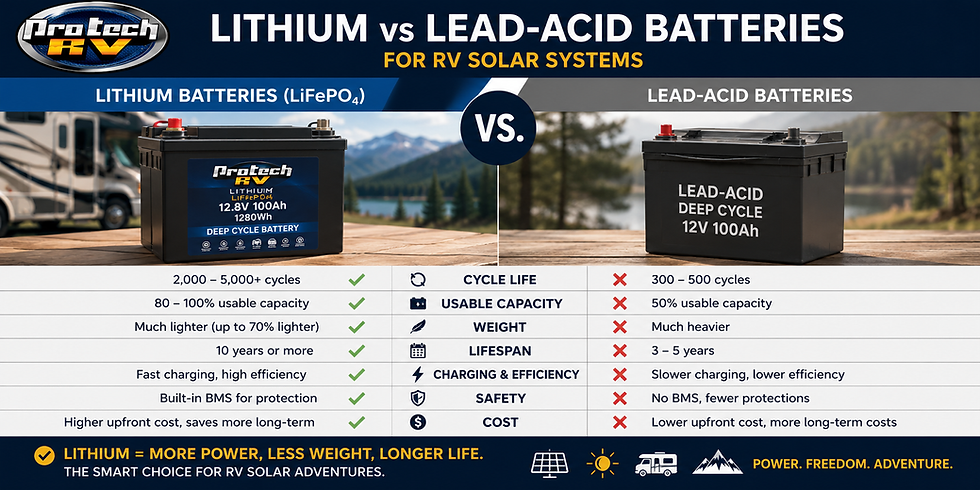
Lithium batteries weigh about one-third of AGM batteries and offer 5,000 to 10,000 cycle life compared to AGM's 400 to 1,000 cycles. Lithium provides 80-100% usable capacity versus AGM's 50% depth of discharge. Lithium batteries are over 95% efficient while lead-acid batteries only reach 80-85% efficiency.
Can RV Solar Run an Air Conditioner
RV air conditioners need 1,500-3,500 watts to start and 500-1,500 watts to run. Running AC requires multiple panels totaling 1,000-2,000 watts and at least 200-400 Ah of battery capacity. A high-capacity system with a 5,000 Wh battery, 90% inverter efficiency, and 1,000 watts of solar panels can run a 1,000-watt air conditioner for about 10.5 hours per day under optimal conditions.
An RV solar system isn't guesswork. It's about matching your ground application power usage with a properly designed system. Pro Tech RV specializes in custom RV solar design, lithium battery upgrades, and full off-grid electrical solutions tailored to real camping conditions.
Common RV Solar Sizing Mistakes and How to Avoid Them
The biggest mistakes in RV solar system sizing happen if owners guess at their needs, underestimate usage, or buy equipment that doesn't work together.
Under-Sizing Your System for Future Needs
Buying too small costs more at upgrade time. Plans for frequent boondocking mean spending extra upfront for adequate capacity prevents expensive modernizations. Undersizing forces batteries to work harder and fail before their time. Building in extra capacity now saves money and frustration down the road.
Over-Sizing and Wasting Money on Unused Capacity
Your battery reaches 100%, and excess solar production goes nowhere. You can't sell surplus power back to utilities like residential systems. Oversizing beyond your consumption pattern means paying for panels that generate wasted energy. Size your system to recover daily usage rather than maximizing roof coverage.
Mismatched Components That Create Inefficiency
Voltage and current mismatches between panels reduce total system output by a lot. Mismatched batteries cause 90% of hybrid-inverter service calls. Components that don't communicate or operate outside optimal ranges see efficiency drops and equipment fails faster. Proper component matching will give everything peak performance.
Why Professional RV Solar Design Matters
Professional RV solar installations average 80 hours of labor. Experts match panels, inverters, batteries, and charge controllers so everything functions as it should. Building it right the first time saves money, time, and avoidable frustration.
Conclusion
RV solar sizing done right eliminates guesswork and prevents mistakes that get pricey. As shown above, you need to calculate ground power consumption, size components the right way, and account for your actual camping style. Small miscalculations lead to underpowered systems or wasted capacity. Professional RV solar design ensures your panels, batteries and inverter work together so you can boondock with confidence rather than power anxiety.
Key Takeaways
Understanding your actual power needs is the foundation of successful RV solar system design, preventing costly oversizing or undersizing mistakes.
• Calculate real daily power consumption by listing all devices, measuring actual usage hours, and adding 15-20% buffer for system inefficiencies • Size solar panels using the 30 amp-hour rule: divide daily usage by 30 to determine how many 100-watt panels you need • Choose lithium batteries for 80-100% usable capacity and 5,000+ cycles versus lead-acid's 50% capacity and 400-1,000 cycles • Match all components properly - mismatched voltage and current between panels reduces total system output significantly • Consider real-world factors like travel style, regional sunlight hours, and roof space limitations when finalizing your system design
Professional RV solar design matters because proper component matching and installation prevents the 90% of service calls caused by mismatched equipment, ensuring your system performs reliably for years of off-grid adventures.
FAQs
Q1. How much solar power do I need to run an RV air conditioner? Running an RV air conditioner requires 1,000-2,000 watts of solar panels and at least 200-400 Ah of battery capacity. The AC unit itself typically needs 1,500-3,500 watts to start and 500-1,500 watts to run continuously. Under optimal conditions with a 5,000 Wh battery and 1,000 watts of solar, you can expect approximately 10.5 hours of air conditioning per day.
Q2. What's the difference between lithium and lead-acid batteries for RV solar systems? Lithium batteries offer significant advantages over lead-acid options. They provide 80-100% usable capacity compared to lead-acid's 50%, weigh about one-third as much, and last 5,000-10,000 cycles versus 400-1,000 cycles for AGM batteries. Lithium batteries also operate at over 95% efficiency, while lead-acid batteries only reach 80-85% efficiency.
Q3. How do I calculate how many solar panels I need for my RV? Start by calculating your daily power consumption in amp-hours. A 100-watt solar panel generates approximately 30 amp-hours per day under typical conditions. Divide your daily usage by 30 to determine how many 100-watt panels you need, then add 20-25% extra capacity to account for cloudy weather and system inefficiencies.
Q4. Should I choose a PWM or MPPT charge controller for my RV solar system? MPPT charge controllers are 5-30% more efficient than PWM controllers and work better for larger systems. PWM controllers are suitable for smaller systems under 440 watts and cost less, but MPPT controllers convert excess voltage into amperage and perform significantly better in systems above 400 watts or in cold climates where voltage increases.
Q5. Can I install an RV solar system myself or do I need a professional? While DIY installation is possible, professional installation offers significant advantages. Experts ensure proper component matching, which prevents the 90% of service calls caused by mismatched equipment. Professional installations average 80 hours of labor and guarantee that panels, inverters, batteries, and charge controllers work together at peak performance, saving money and frustration in the long run.
Most RV owners get their RV solar system sizing wrong the first time. The consequences get pricey. Undersized systems force batteries to overwork and fail prematurely, while oversized setups waste money on unused capacity. Determining how much solar you need for your RV isn't guesswork. It's about matching your actual power consumption with the right combination of solar panels and batteries. A 100-watt solar panel generates 30 amp-hours per day, but your needs depend on travel style, appliances, and weather conditions. In this piece, I'll walk you through calculating ground power usage and sizing each component while avoiding the common mistakes that lead to frustration on the road.


Comments