


Why RV Solar Panels in Lake Havasu Make Boondocking Actually Possible
Updated: May 5

Lake Havasu offers 73 boat access campsites along 20 miles of Arizona shoreline, available first-come, first-serve with a 14-day stay limit. Reliable rv solar panels lake havasu can deliver are crucial to get the most from these remote desert locations, especially when you have summer temperatures that just need air conditioning and generator use faces restrictions.
This piece walks through everything about solar power for rv havasu setups. We'll cover why solar panels for rvs havasu are essential and how to build systems for different camping durations. You'll learn to calculate ground power needs and maximize solar energy for rvs havasu in harsh desert conditions.
Why Lake Havasu demands reliable off-grid power
Remote shoreline camping locations
You'll need to launch a boat to access most camping spots around Lake Havasu. The majority of the 73 shoreline sites managed by BLM are boat-access only. Each site provides a picnic table, barbecue grill, and trash receptacle. Most offer a restroom and shade structure. What these sites don't provide is electrical hookups or any source of power.
Dispersed camping areas north and south of the city present similar challenges. Craggy Wash sits 8.4 miles from the city center. Standard Wash stretches out 10.5 miles. The Steps pushes even further at 17.6 miles from Lake Havasu City. Getting supplies or accessing utilities from these distances turns into an expedition, especially when you have settled in for multiple days.
The terrain adds another layer of complexity. Road conditions vary in these desert locations. Some areas feature nicely graveled surfaces. Others require navigating rough, rocky paths. Campers at certain dispersed sites report that cellular service becomes spotty. AT&T shows 3 bars in some locations while Verizon struggles. This remoteness means you can't rely on running back to town when power runs low.
Summer heat and air conditioning requirements
Desert temperatures at Lake Havasu exceed 110°F during summer months. The elevation hovers around 500 feet and sits in the Sonoran Desert where the climate makes rain preparation unnecessary. One camper reported temperatures just under 90°F at midnight, with rocky ground adding to sleep challenges.
Running air conditioning in these conditions isn't optional if you want comfortable camping. The heat affects every aspect of desert living, from keeping cool during midday to maintaining safe interior temperatures for pets or heat-sensitive supplies. Without reliable solar power for rv havasu setups, your options narrow to either burning through expensive campground fees for hookups or running generators constantly.
Limited generator use in BLM areas
Stage 2 fire restrictions create a major obstacle for traditional power generation. These restrictions prohibit operating any internal combustion engine. The restriction applies to developed BLM campsites and extends to dispersed areas during high fire danger periods.
Stage 2 also bans building, maintaining, or using fires, charcoal, coal, or wood stoves. You can only smoke inside enclosed vehicles or buildings. Even discharging firearms faces restrictions except during lawful hunting. When fire danger escalates, your generator becomes useless whatever amount of fuel you're carrying.
Conditions are more favorable for camping from October through April. But even winter visits can bring cold and windy weather that demands heating solutions. Solar panels for rvs havasu provide consistent power year-round without violating restrictions.
Extended stay opportunities with proper power
The 14-day stay limit within any location opens up extended camping possibilities when you have adequate power reserves. Day use passes cost $10. Overnight stays run $10 per night for up to 6 individuals, with each additional person adding $2. Children under 16 camp free.
An annual pass valued at $100 covers the year for frequent visitors. This pass makes financial sense if you're planning multiple trips or extended stays throughout the season. Staying the full 14 days on a single visit would cost $140 in overnight fees. The annual pass pays for itself in just two weeks of camping.
Setting up solar power for camper havasu systems transforms these extended stays from endurance tests into comfortable experiences. You're not rationing battery power or calculating generator runtime. Fresh water systems, refrigeration, and climate control operate as needed. The difference between adequate solar energy for rvs havasu and insufficient power determines whether you enjoy the full 14 days or pack up early when batteries die.

What makes solar panels for RVs Havasu Essential
Consistent Arizona sunshine year-round
Arizona ranks as one of the best states for solar power generation and receives a peak of 6.5 sun hours daily. This figure represents actual usable sunlight that reaches 1,000 watts of power per square meter, not just daylight hours. Fixed solar panels in Arizona capture an average of 6.57 peak sun hours and provide consistent energy production even during winter months.
The Lake Havasu region benefits from nearly 200 clear sunny days each year. Summer months from April through August deliver the highest peak sun hours. Winter months from November to February show the lowest production. Solar output remains sufficient for running essential rv solar panels havasu systems without supplemental charging even during these slower months.
This consistent sunshine gives solar power for rv havasu setups a major advantage over locations farther north. The smaller your system just needs to be, the lower your costs run. Arizona's abundant sunlight means you can install fewer panels than campers in cloudier climates while generating the same power output.
Running air conditioners without hookups
Air conditioners just need substantial power. A typical 15,000 BTU unit requires about 3,500 watts just to start and 1,500 watts to keep running. Traditional RV batteries can't sustain these loads for more than a few hours. A soft start component reduces startup power requirements from 3,500 watts down to 1,500-2,000 watts and makes solar-powered cooling feasible.
You just need at least 1,800 watts of solar panels with an 800 amp-hour battery bank to run a single AC for 8 hours each day. One camper reported success running a 12,000 BTU mini-split with 2,650 watts of solar and 10 kWh of batteries. The system maintained 24/7 operation for 10 days without dropping below 50% battery capacity. The battery level drops to 50-60% at night and recovers to 100% by noon or 1 PM each day.
Mini-split systems offer greater efficiency than standard RV air conditioners and draw roughly 25% or less power while providing better cooling performance. These units start slowly without hammering the inverter and allow operation on smaller power systems. This efficiency difference determines whether cooling remains viable during extended stays for solar power for camper havasu applications.
Keeping refrigeration and water systems operational
RV refrigerators average 50 to 60 watts and consume about 2.5 amps per hour. A 200-watt solar panel generating 10 to 12 amps per hour can power an RV fridge for 24 hours without interruption. Solar panels charge batteries that store electricity for nighttime operation when panels produce nothing.
Most RV campers consume about 20 kilowatt hours of electricity each day. The more appliances running, the higher your usage climbs. Battery banks store solar energy during peak production hours so refrigeration keeps operating after sunset. Lead-acid batteries remain common for RV use, though portable lithium-ion batteries are gaining popularity for their higher energy density.
Charging devices and running entertainment systems
Solar panels for rvs havasu excel at powering low-voltage appliances like lights, fans and device chargers. These quiet power sources eliminate generator noise while providing renewable energy. You just need adequate solar panel capacity with proper battery storage and an inverter to convert DC power into usable AC power to run entertainment systems, microwaves and coffee makers.
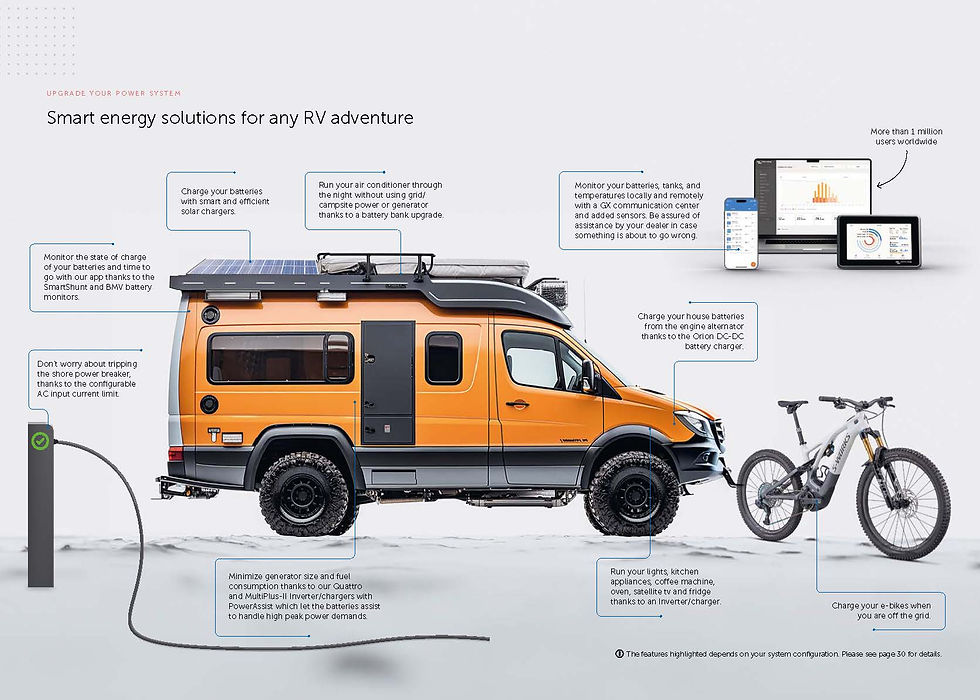
A complete solar power for motorhome havasu system has four main components: solar panels, a charge controller to prevent battery overcharging, an inverter to convert DC electricity to AC power, and batteries to store the electricity. The charge controller creates a one-way street for energy and channels power from panels to your battery bank.
Building your RV solar system from the ground up
Starter systems for weekend boondockers
Roof space determines maximum panel capacity on any RV. You can measure available area or use cardboard cutouts to target sixty-cell panel formats measuring roughly 67 inches by 40 inches. These panels represent the best value and performance due to high sales volume.
Weekend warriors need 100 to 200 watts of solar panels combined with a charge controller, cables, connectors and mounting hardware. A simple 100-watt starter kit produces approximately 500 watt-hours daily based on five hours of direct sunlight. This output powers LED lights, smartphone and laptop charging, plus small appliances like portable coolers or fans.
Mid-range setups for weekly stays
Typical boondocking just needs 300 to 500 watts of solar panels paired with an MPPT charge controller, deep cycle AGM or lithium batteries, an inverter for motorhome havasu applications, plus cables and fuses. This configuration powers LED lights, device charging, TV and entertainment systems, refrigerators, water pumps and fans.
Mid-range systems handle small electronics plus periodic microwave, coffee maker, hair dryer and electric blanket use. These appliances draw substantial power but operate for minutes daily, which makes them manageable on properly sized systems. A 400 to 600-watt array with 450 amp-hours of batteries meets most weekly camping needs.
Full-time systems for extended desert living
Extended desert living just needs 600 watts or more of rv solar panels lake havasu installations, MPPT charge controllers with advanced features, multiple lithium iron phosphate cells and high-output inverters. These systems power all mid-range appliances in addition to microwave ovens, smaller air conditioning units, coffee makers, blenders and limited electric heater use. Full-time setups require 800 to 1,200 watts of solar paired with 600 to 800 amp-hours of lithium batteries.
Professional installation versus DIY approaches
DIY solar systems for camper with solar panels in Havasu may save on labor, but, the approach but cutting corners could cost you thousands. Mistakes during installation reduce efficiency or damage your RV's electrical setup.
Professionals minimize installation errors and create more reliable, long-lasting systems.
Do you plan to spend more time boondocking off-grid? Let Pro Tech RV help you power your adventures with custom RV solar panels in Lake Havasu. Our team is here to help you stay comfortable, connected and ready for the road with Victron-based systems and complete solar and battery upgrades. Contact us today to get started.
Real-world power needs for Lake Havasu camping

Daily power consumption calculations
You can prevent undersized solar power for rv havasu systems when you calculate your actual energy needs. Light weekend users consume 1 to 3 kWh per day. Moderate boondockers draw 3 to 6 kWh daily, while full-time off-grid setups just need 6 to 12+ kWh per day. Most RVers boondocking without hookups try staying under 1 to 4 kWh daily to avoid draining batteries too fast.
The calculation formula multiplies watts by hours used per day to get watt-hours. A 100W laptop consumes 500Wh when it runs 5 hours. A 120W fridge uses 960Wh when it operates 8 hours. Add 15 to 20% buffer capacity for inverter losses and inefficiencies.
Running appliances during peak heat
Air conditioning dominates power consumption at Lake Havasu. A standard RV A/C draws 1,200 to 1,800 watts while running. You need about 10 to 14 kWh per day to operate it 8 hours during summer heat. A 13,500 BTU unit needs 2,700 to 3,000 watts to start, dropping to 1,500 to 1,800 watts once running.
Modern 12V refrigerators consume 40 to 70Ah daily at 12V. This translates to about 0.5 to 0.8 kWh. They cycle on and off, making them efficient compared to air conditioning loads.
Water pump and filtration requirements
The standard Shurflo pump draws 7.5 amps at 12V, equaling 90W. It consumes 22.5 Watt Hours when you run it 15 minutes total throughout the day. Water pump usage falls under 0.1 kWh in total daily consumption, making it negligible compared to climate control needs.
Lighting and device charging needs
Most RV lighting systems consume 0.2 to 0.4 kWh per day. Cell phone chargers use about 0.03 kWh daily per device. Two smartphones and tablets combined draw 3 to 5 Ah daily when charging, representing minimal effect on overall solar power panels for rv havasu capacity requirements.
Maximizing solar performance in desert environments
Panel positioning and tilt angles
A panel tilt angle that matches your latitude provides optimal year-round performance. Lake Havasu sits at roughly 34°N. A 34-degree tilt is ideal for fixed installations. Winter tilting increases solar output by 40%, while summer requires flatter angles since the sun sits high overhead. A minimum 10-degree angle for panels allows rainwater to wash away surface dust and prevents water staining.
Dust and debris management
Dust accumulation reduces solar panel output by 30% in just one month. Research shows panels can lose 40-50% of their power due to desert dust buildup. Regular cleaning maintains efficiency. Waterless electrostatic systems work when humidity exceeds 30%. Desert regions fall within this humidity range, which makes automated cleaning viable for solar power for rv havasu installations.
Temperature effects on efficiency
Solar panels lose 0.3% to 0.5% efficiency for every degree above 25°C. Heat can reduce output by 10-25% during peak summer temperatures. Rv solar panels lake havasu setups a few inches above your roof promote airflow that dissipates heat. This spacing prevents panels from absorbing excessive roof heat and maintains cooler operating temperatures.
Monitoring battery health and charge cycles
Charge controllers manage three-stage charging that includes bulk and absorb phases. Monitoring systems track voltage and current along with state of charge. You can spot efficiency drops before they become problems.
Upgrading and expanding your system over time
Expansion kits add capacity to existing solar panels for rvs havasu setups. MC4 branch connectors enable parallel wiring between panels. Incremental upgrades become straightforward as your power needs grow.
Conclusion
Lake Havasu's remote shoreline camping becomes available when you build the right solar setup. Arizona's consistent sunshine provides reliable power generation year-round and makes desert boondocking comfortable rather than a test of endurance. Weekend systems starting around 200 watts handle simple needs. Full-time setups that require 1,200 watts support air conditioning through brutal summer heat.
The investment pays off quickly when you stay the full 14-day limit without generator restrictions or expensive hookup fees. Proper planning transforms your power system from an afterthought into the foundation of extended desert adventures. Calculate your needs, size your components so they match, and you'll enjoy every day at Lake Havasu without rationing batteries or cutting trips short.
Pro Tech RV
1595 Dover Ave., Ste B
Lake Havasu City, AZ 86404
928-733-8850
Comments