


Can RV Solar Run Air Conditioning in Arizona Heat?

You want the best solar air conditioner for RV use in Arizona. This means you need to understand a critical reality: standard 13,500 BTU RV air conditioners need 1,500 to 3,500 watts to start and 500 to 1,500 watts to run. Summer temperatures regularly exceed 100°F in Lake Havasu City. This creates a unique challenge. Arizona's abundant sunshine makes solar appealing, but the intense heat also creates higher cooling demands than most RVs experience elsewhere.
Can solar run your RV AC? The answer depends on your battery capacity and inverter size. System efficiency and cooling duration needs matter too. We'll walk you through the realistic power requirements and everything in components. You'll also learn about real-life performance expectations and proper system design for off-grid cooling in Arizona's extreme conditions.
Understanding Power Requirements for RV solar run air conditioning in Arizona Heat
How Much Power Does Your RV Air Conditioner Actually Use
Most RV air conditioners in Lake Havasu fall into predictable power ranges based on their BTU rating. A 13,500 BTU unit, which is standard in most RVs, requires 2,700 to 3,000 watts to start and 1,500 to 1,800 watts to run. Smaller 7,000 BTU units just need 1,600 to 1,800 starting watts and 500 to 700 running watts. Larger 15,000 BTU systems just need 3,200 to 3,500 starting watts and 1,800 to 2,000 running watts.
The unit's EER (Energy Efficiency Ratio) affects actual consumption. A 5,000 BTU unit with a 10 EER uses 500W, while an 11 EER uses 455W and a 12 EER uses 417W. Higher efficiency ratings mean less power draw, but even the most efficient units still consume substantial energy.
Starting Watts vs Running Watts: Why This Matters in Desert Conditions
Your AC compressor just needs surge current at the time of starting that can reach 4 to 8 times the running wattage. This startup spike lasts only 150 milliseconds but can hit 52 amps on a standard unit. Your inverter can get overwhelmed or trip breakers even when your system handles the running load fine if you don't have a soft starter.
Desert conditions make this worse. Manufacturer data shows that each five-degree increase above 95°F adds about 120 watts to your air conditioner's power consumption. Your 13,500 BTU unit that draws 1,500 watts could pull 1,980 watts or more during peak afternoon heat at the time Lake Havasu hits 115°F in July.
Battery Bank Capacity: The Real Limiting Factor
A typical 100Ah 12V lithium battery holds about 1,200 watt-hours of usable energy. A single battery depletes in under an hour at full AC load. A 13,500 BTU air conditioner consumes 12,000 to 14,400 watt-hours for eight hours, which means you just need substantial battery capacity.
You just need at least 4 to 6 lithium batteries paired with an efficient AC unit to achieve overnight cooling. Larger systems may require 400 to 800 amp-hours of lithium capacity for reliable eight-hour runtime. Battery banks deplete quickly under continuous heavy draw, and off-grid charging sources keep up with AC consumption during operation nowhere near as well.
Essential Components for Solar-Powered RV Air Conditioning
Building a solar air conditioner for RV systems in Lake Havasu requires four interconnected components that must work together under Arizona's demanding conditions.
Solar Panels: How Many Do You Really Need
An RV air conditioner requires multiple panels totaling 1,000 to 2,000 watts, depending on your AC unit's power requirements. Monocrystalline panels offer best efficiency in limited roof space. A 13,500 BTU AC running several hours daily could require 800 to 1,200 watts of solar panels to replenish the battery bank. For serious AC usage, you want 2,000 to 3,000 watts of solar panels. Panels rarely produce their full rated power because of ground conditions like temperature, angle and partial shading.

Lithium Batteries vs Lead-Acid for Arizona Summers
Lithium batteries provide 80-90% depth of discharge compared to only 50% for AGM batteries. A lithium battery with 100Ah capacity delivers 80-90Ah of usable power. AGM offers only 50Ah before recharging. Lithium batteries weigh one-third as much as lead-acid batteries. Arizona's summer heat allows lithium batteries to operate up to 140°F, though some manufacturers recommend keeping them below 114°F during charging. Lithium batteries charge four times faster than lead-acid and last up to 5,000 cycles compared to 500-800 for AGM.
Inverters and Charge Controllers for High-Demand Cooling
Pure sine wave inverters are essential for compressor-based appliances. You just need an inverter rated between 3,500 and 4,000 watts to avoid maxing out capacity. MPPT charge controllers charge batteries 10-30% more efficiently than PWM types. An MPPT controller rated to handle your total solar panel wattage prevents overcharging.
Soft Starters: Reducing Your Power Requirements
Soft starters reduce startup surge by 50-75%. This reduction allows smaller inverters to handle AC startup without overload. Compressors draw 4-8 times their running current at startup without soft starters.
Real-World Solar AC Performance in Arizona
Can You Run Your AC During Peak Afternoon Heat
Solar panels struggle to keep pace with AC demand during Lake Havasu's hottest hours. A rooftop AC draws 1,200 to 1,800 watts without pause. Even large solar arrays cannot produce enough power in real time. Hot panel surfaces reduce efficiency. Flat-mounted panels rarely deliver full wattage. A 1,200-watt solar setup paired with 400Ah lithium batteries provides 2 to 3 hours of cooling on a sunny afternoon. But cloud cover, extreme heat and high humidity affect performance substantially.
Overnight Cooling: What's Actually Possible
Overnight AC operation drains batteries without solar recharge until sunrise. Most systems provide 4 to 6 hours during mild evening conditions. You need at least 4 to 6 lithium batteries paired with DC or variable-speed AC units for eight-hour overnight cooling. One RVer with nine 100Ah lithium batteries can run AC all night for more than 8 hours. Your battery bank drains overnight when you run AC, so you must wait until sunrise for recharge if relying on solar alone.
Factory Solar Packages vs Custom Professional Systems
Factory 300-watt solar packages include simple controllers and 100Ah lead-acid batteries that fall short for serious boondocking. One Airstream owner's factory system couldn't last a single night using only the refrigerator before batteries went into sleep mode. Factory systems work fine for weekend RV park camping but lack the capacity needed for AC operation. Custom professional systems with 1,000 to 2,000 watts of solar and 600 to 800Ah lithium capacity extend runtime substantially.
Ready to find out if your RV solar system can handle Arizona's summer heat? The team at ProTech RV can help you choose the right solution for your RV and travel style, whether you're looking to run your air conditioner while boondocking, upgrade to lithium batteries or build a complete off-grid solar setup. Our experienced technicians specialize in RV solar systems, inverters, batteries and electrical diagnostics designed for the demanding conditions of Lake Havasu and the Southwest.
Solar vs Generator: Which Works Better in Lake Havasu
Generators provide consistent power as long as fuel lasts and can run multiple AC units at once. Solar offers silent operation and free fuel but requires significant stored energy for nighttime cooling. A hybrid approach provides better comfort for extended AC use during low solar production periods. Many Lake Havasu boondockers run generators for quick battery charging or direct AC operation during peak demand, then switch to solar-charged batteries for quieter evening hours.

Designing Your RV Solar System for Arizona Conditions
Calculating Your Specific Battery and Solar Needs
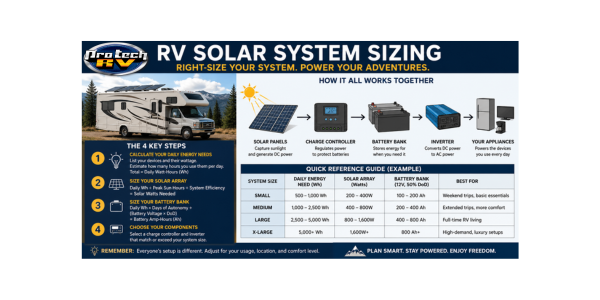
Start by calculating daily watt-hours: multiply your AC's running watts by hours of daily use. To cite an instance, a 1,500-watt AC running 4 hours consumes 6,000 watt-hours. Add 15-25% to account for system inefficiencies during conversion and battery charging. You want 10,350 to 11,250 Wh from your panels if you need 9,000 Wh.
Divide your adjusted total by peak sun hours (4-5 hours) to determine minimum solar wattage. An 11,000 Wh requirement with 5 sun hours needs about 2,200 watts of solar panels. Convert watt-hours to amp-hours by dividing by system voltage. A 7,500 Wh need requires at least 625 amp-hours at 12V.
Common Mistakes RV Owners Make with Solar AC Systems
RV owners make one frequent error: they overestimate solar production. A 200-watt panel rarely produces 200 watts in real-life conditions due to heat, angle, and shading. RV owners also underestimate battery needs and create short cooling windows since air conditioning requires sustained high-current draw. Older rooftop units become difficult to run off inverters when you assume any AC can operate on solar without soft-start devices. Clouds, haze, or partial shade affect energy generation by a lot when you forget weather dependency.

Why Professional Installation Matters in Extreme Heat
Professional installers charge USD 100 to USD 150 per hour, with complete systems ranging from USD 2,000 to USD 10,000+ installed. Proper component configuration prevents costly mistakes and will give optimal efficiency.
Don't guess when it comes to staying cool and comfortable on the road. Contact ProTech RV today for a professional evaluation of your RV's solar and electrical system and find what's possible with a properly designed RV solar air conditioning setup.
ProTech RV Serving Lake Havasu City and surrounding Arizona communities Call today to schedule your RV solar consultation and system assessment.
Setting Realistic Expectations for Off-Grid Cooling
Solar supports cooling but shouldn't replace shore power consistency unless your system is very large. Most systems provide several hours of AC use during the hottest parts of the day or comfortable overnight sleep rather than continuous 24-hour operation.
Conclusion
You can run your RV air conditioner on solar in Lake Havasu when you size your system correctly. Success depends on having enough battery capacity, enough solar panels and realistic expectations about runtime. Arizona's intense summer heat demands more power than milder climates, so professional system design becomes a must. A properly configured solar setup gives you freedom to boondock comfortably without sacrificing the cooling you just need.
Key Takeaways
Yes, RV solar can run air conditioning in Arizona heat, but success requires proper system sizing and realistic expectations about performance limitations.
• Power demands are substantial: A 13,500 BTU RV AC needs 2,700-3,000 watts to start and 1,500-1,800 watts to run continuously • Battery capacity is the limiting factor: You need 4-6 lithium batteries (400-600Ah) for reliable overnight cooling in desert conditions • Solar array must be oversized: Plan for 2,000-3,000 watts of panels to adequately recharge batteries after AC use • Soft starters reduce power requirements: These devices cut startup surge by 50-75%, allowing smaller inverters to handle AC operation • Professional installation prevents costly mistakes: Proper component sizing and configuration ensures optimal efficiency in extreme heat conditions
While factory solar packages fall short for serious AC use, custom professional systems with adequate lithium capacity can provide 4-8 hours of cooling. The key is understanding that solar AC works best as part of a hybrid approach rather than expecting 24/7 operation like shore power.
FAQs
Q1. How many solar panels do I need to run my RV air conditioner?
The number of solar panels depends on your AC unit's power consumption and how long you plan to run it. For a typical 13,500 BTU RV air conditioner used several hours daily, you'll need approximately 1,000 to 2,000 watts of solar panels. For serious AC usage with extended runtime, aim for 2,000 to 3,000 watts of solar capacity to adequately recharge your battery bank after cooling periods.
Q2. Can solar panels power an air conditioner in extreme heat like Phoenix or Arizona summers?
Yes, solar panels can power an air conditioner in extreme Arizona heat, but it requires a properly sized system with adequate battery storage. While solar panels generate plenty of power during sunny days, the AC's high power draw (1,500-1,800 watts continuously) means panels alone can't keep up in real-time. You'll need a substantial battery bank of 400-600Ah lithium capacity to store energy for cooling during peak heat and overnight operation.
Q3. Why does my RV air conditioner trip the power when starting on solar?
Air conditioners require a surge of power at startup—typically 2,700 to 3,000 watts for a 13,500 BTU unit—which can overwhelm your inverter or battery system. This startup spike can be 4 to 8 times the normal running wattage. Installing a soft starter device reduces this surge by 50-75%, allowing your solar system to handle the AC startup without tripping breakers or overloading the inverter.
Q4. How long can I run my RV air conditioner on batteries and solar power?
Runtime depends on your battery capacity and AC efficiency. A typical setup with 1,200 watts of solar and 400Ah of lithium batteries provides 2 to 3 hours of cooling during sunny afternoons. For overnight cooling, you'll need at least 4 to 6 lithium batteries (400-600Ah total) to achieve 4 to 8 hours of operation. Larger systems with 600-800Ah can provide extended all-night cooling in moderate conditions.
Q5. Are mini-split air conditioners better than standard RV AC units for solar power?
Yes, mini-split systems with inverter technology are significantly more efficient for solar applications. They use much lower power than traditional RV rooftop units and feature soft-start capabilities that reduce startup surge. Some DC mini-splits can even connect directly to solar panels and adjust cooling output based on available solar power, making them ideal for off-grid use without requiring massive battery banks.

Comments